Read time:
5 mins

Myelodysplastic syndromes (MDS) are a group of disorders in which the bone marrow does not produce healthy blood cells effectively. Abnormal blood-forming cells can result in low levels of red blood cells, white blood cells, and platelets.
MDS primarily affects older adults, although it can occur at other ages. The condition varies significantly from person to person. Some forms progress slowly and may be managed for years, while higher-risk MDS can progress to acute myeloid leukemia (AML).
Early and accurate diagnosis is important because treatment depends on the specific type of MDS, its risk category, genetic characteristics, and the patient's overall health.
What Are Myelodysplastic Syndromes?
The bone marrow is the body's blood-cell production centre. It contains blood-forming stem cells that develop into red blood cells, white blood cells, and platelets.
In MDS, abnormal changes in blood-forming stem or progenitor cells interfere with normal blood-cell production. The bone marrow may contain abnormal cells, but fewer healthy mature blood cells reach the bloodstream.
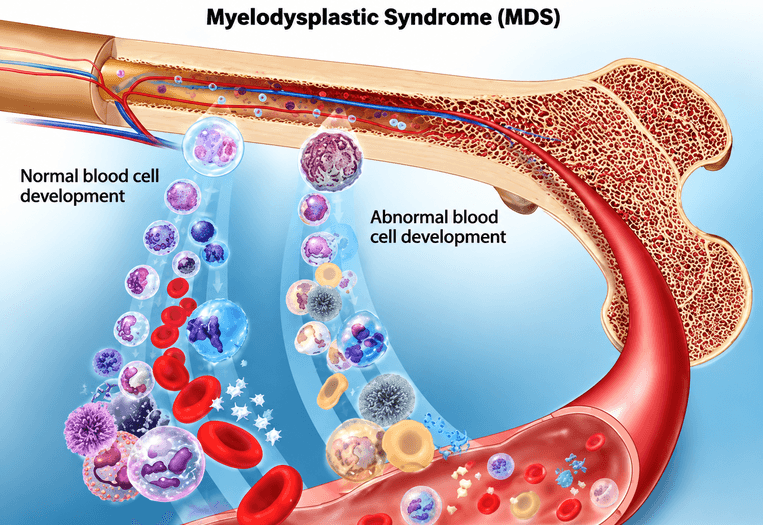
This can lead to:
Anemia due to low red blood cells
Increased infections due to low or abnormal white blood cells
Bleeding or bruising due to low platelets
MDS is not a single disease. It represents a group of related bone marrow disorders with different biological and genetic characteristics.
Types and Risk Categories of MDS
Modern classification systems use blood and bone marrow findings along with genetic and molecular information to classify MDS.
Doctors also assess the risk of the disease using factors such as:
Blood cell counts
Percentage of blasts in the bone marrow
Chromosomal abnormalities
Genetic mutations
Severity of cytopenias
Other disease-related features
MDS is generally categorised into lower-risk and higher-risk disease groups.
Lower-risk MDS may primarily cause persistent low blood counts and symptoms related to anemia or other cytopenias.
Higher-risk MDS has a greater likelihood of progressing to AML and generally requires more intensive treatment.
What Causes MDS?
In many patients, the exact cause of MDS is unknown.
MDS can develop because of acquired genetic changes in blood-forming cells. These changes are usually not inherited from parents.
Certain factors can increase the risk of developing MDS, including:
Increasing age
Previous chemotherapy
Previous radiation therapy
Exposure to certain chemicals
Certain inherited disorders
Previous treatment for another cancer
MDS that develops after previous chemotherapy or radiation is sometimes referred to as therapy-related MDS.
Having a risk factor does not mean that a person will definitely develop MDS.
Symptoms of Myelodysplastic Syndromes
Symptoms are often related to low blood-cell counts.
Symptoms of Anemia
Low red blood cell or hemoglobin levels can cause:
Fatigue
Weakness
Shortness of breath
Dizziness
Pale skin
Reduced ability to exercise
Symptoms Related to Low White Blood Cells
A low or abnormal white blood cell count may increase the risk of infections.
Possible symptoms include:
Recurrent infections
Persistent fever
Frequent illness
Slow recovery from infections
Symptoms Related to Low Platelets
Low platelet levels can increase the risk of bleeding.
Possible signs include:
Easy bruising
Frequent nosebleeds
Bleeding gums
Small red or purple spots on the skin
Prolonged bleeding from minor injuries
Some people with MDS have no obvious symptoms and are diagnosed after an abnormal blood test performed for another reason.
How Is MDS Diagnosed?
A persistent unexplained reduction in one or more blood cell types may lead a doctor to investigate MDS.
Complete Blood Count
A complete blood count (CBC) measures red blood cells, white blood cells, hemoglobin, and platelets.
The results may show one or more low blood cell counts.
Peripheral Blood Smear
A blood smear allows a specialist to examine the appearance of blood cells under a microscope.
Certain abnormalities in the shape, size, or maturity of blood cells may provide clues to an underlying bone marrow disorder.
Bone Marrow Aspiration and Biopsy
A bone marrow examination is an important part of diagnosing MDS.
It allows doctors to evaluate:
The number and appearance of developing blood cells
Abnormal cell development, known as dysplasia
Blast percentage
Bone marrow cellularity
Other abnormalities that may help distinguish MDS from other conditions
Cytogenetic and Molecular Testing
Genetic and molecular testing has become an important part of MDS evaluation.
Chromosome analysis and molecular tests can identify abnormalities that help:
Confirm or refine the diagnosis
Classify the disease
Estimate disease risk
Provide prognostic information
Guide treatment decisions
How Is MDS Treated?
Treatment is individualised according to the patient's risk category, symptoms, blood counts, genetic findings, age, overall health, and treatment goals.
Some patients may initially require close monitoring, while others need active treatment.
Observation and Monitoring
Patients with lower-risk disease and limited symptoms may sometimes be monitored regularly.
This can include periodic blood tests and clinical assessment.
Treatment may begin if blood counts worsen, symptoms develop, transfusion requirements increase, or other signs indicate that intervention is needed.
Supportive Care
Supportive care focuses on managing the effects of low blood counts.
It may include:
Red blood cell transfusions
Platelet transfusions when required
Treatment of infections
Iron management in patients receiving repeated transfusions
Medicines to improve blood-cell production in selected patients
Supportive care can play an important role in maintaining quality of life.
Growth Factors
Certain medicines can stimulate the bone marrow to produce more blood cells.
For selected patients with anemia, erythropoiesis-stimulating agents may help reduce transfusion requirements.
The decision to use these medicines depends on disease characteristics and individual patient factors.
Disease-Modifying Treatment
Certain medicines can modify the behaviour of abnormal bone marrow cells and are used particularly in higher-risk MDS.
Hypomethylating agents such as azacitidine and decitabine are important treatments for many patients with higher-risk disease.
Stem Cell Transplantation
Allogeneic hematopoietic stem cell transplantation is currently the only treatment with established curative potential for MDS.
It involves replacing the patient's diseased blood-forming system with healthy stem cells from a donor.
However, transplantation is an intensive treatment and carries significant risks. It is therefore considered based on factors such as disease risk, age, overall health, donor availability, and the patient's suitability for transplantation.
Can MDS Progress to Leukemia?
Yes. Some forms of MDS can progress to acute myeloid leukemia (AML).
The risk depends on the specific type and biological characteristics of the MDS.
Higher-risk disease generally has a greater likelihood of progression than lower-risk disease.
This is one reason why accurate risk assessment and regular monitoring are important.
MDS and Anemia
Anemia is one of the most common problems associated with MDS.
However, not every case of anemia is caused by MDS.
Iron deficiency, vitamin B12 deficiency, chronic disease, kidney problems, blood loss, and several other conditions can also cause anemia.
Persistent anemia, particularly when it is unexplained or accompanied by abnormalities in other blood cell lines, may require evaluation by a hematologist.
Living With MDS
Living with MDS can vary significantly depending on the disease risk and treatment required.
Some patients may need only regular monitoring, while others may require frequent transfusions or active therapy.
Patients should maintain regular follow-up with their healthcare team and report symptoms such as:
Fever
New or worsening infections
Unusual bleeding
Significant fatigue
Shortness of breath
New unexplained bruising
A personalised care plan can help manage symptoms, reduce complications, and maintain quality of life.
When Should You See a Hematologist?
You may be referred to a hematologist if you have:
Persistent unexplained anemia
Low white blood cell counts
Low platelet counts
More than one abnormal blood cell type
Abnormal findings on a peripheral blood smear
Recurrent infections or unexplained bleeding
Persistent blood count abnormalities without an identified cause
An abnormal blood test does not automatically mean that you have MDS. A hematologist can determine whether further testing, including a bone marrow examination, is appropriate.